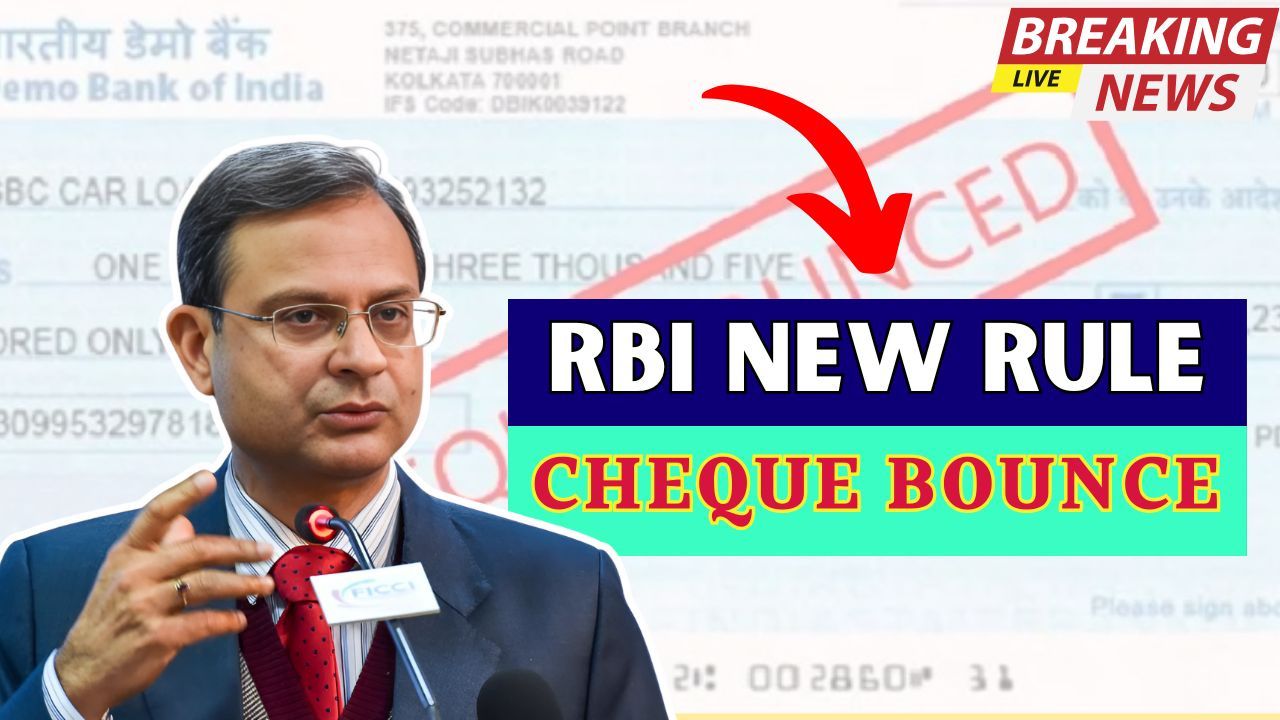
Formally introducing more severe rules against cheque bouncing by the RBI to be in force in 2026 was a very welcome development. The initiative further aims to reduce financial fraud or rather dares to promote trust in cheque-based transactions through swifter justice to payee victims. With heavyweight penalty and proper demarcation of timelines, stiff penalty has to be a strength to check encouragement to all those defaulters.
What Actually Means Check Bounced
Another reason we have been made to believe is that when a cheque has been issued with a closed account or has been expired, the bank would flatly say, “No cheque can ever be honored.” Kick in: The one-and-half-century-old act of, for example, dishonor of a cheque is punishable under the N. I. Act.
Imprisonment For Cheque Bounce As per Reserve Bank of India’s Cheque Bounce Rules 2026:
Inter alia, a person shall be punished with an extended prison term of two years. Nonetheless, where, in serious cases, or where the misdemeanor was committed more than once for that matter, and it is proved beyond doubt that the said drawer has complete intent to defraud, the court may justify such a penalty. This is targeted at ensuring that habitual offenders and defaulters of high-value amounts are scared to come out.

Provision Regarding Double Fine
Answering the queries, a fine upwards of twice the amount of the cheque was declared due if dishonoured. To give a for-instance, where a cheque bounced for ₹1 lakh, the due penalty could be two hundred thousand — exclusive of legal costs.
Faster Court Process in Cheque Bounce Cases
The first among the 2026 rules is trying to limit the delay in legal litigation for cheque bounce cases. Presumably, several such things as digital evidence, online summons, and summary trials are being put among the approved evidence of having your case settled within short.

Cheque Issuer’s Duties
Cheque issuers would be obliged to maintain a bank balance prior to obtaining a cheque issued. Banks reiterate that checks have got dates of validation and to stop issuing such without even having money credits against them. Ignorance and negligence will not be a defense.
Cheque and the Holder of the Cheque
The payee has the right to send a legal notice within the stipulated timeframe. If payment is still not made within those days, the payee can apply for a criminal case. The payee here is in an advantageous position with the new and strict rules in place.

Impact for Individuals and Businesses
The rule would carry special value to traders, agriculturists, small time industries and small businesses, and all others who deal with cheques on the parameters of trading. In a general sense, there could be rationalization and discipline, thus reducing chaotic practices on the payments side.
Personal takeaway for 2026
The cheeky softening of some assumptions will generate visible results, so that by 2026, the new RBI rules serve up to create an unbearable strain on practices made willy-nilly before. Cheque transactions are about to become more secure and as its killings with a heavy fine punish all shortcomings too.